Marisol, the artist often associated with Andy Warhol in the Pop Art era was not, as many others, one of his creations. She was a well-known star in the art world long before and long after Warhol. The man who dealt in what often appeared as superficiality praised her for being ‘the first girl artist with glamour’. In all the photographs of her she projected defiance and an impenetrable mystery.
This important exhibition at The Depot of Museum Boijmans van Beuningen powerfully puts on show not only Marisol’s work, but also her identity. Her pieces, many surprisingly large, some with echoes of Pre-Colombian figures, consist of the juxaposition of flat and three-dimensional elements, the painted faces exquisitely executed. Also omni-present in various forms are figures of a mother and child, and in most pieces Marisol’s own face appears, always with the same challenging gaze.
This is not the first time Marisol has exhibited at Rotterdam. She had a major exhibition which had travelled from Venezuela in Museum Boijmans van Beuningen in 1968 and in 1972 the new wing of the museum was inaugurated with Marisol as guest of honour celebrating the museum’s purchase of The Car.
Her portraits of leading figures – John Wayne complete with hatted block-head, brandishing a gun on a leaping horse and even the British Royal Family, Corgi included, are cartoon-like. The bold, chunky wooden parts of each piece are in stark contrast with the fine details of the faces that translate the characters with astonishing accuracy. In all of them she unerringly found the essence of a person, not unlike a cartoonist. Three rectangular blocks and an umbrella suffice to give us René Magritte; a single rectangle, a mask and a staff conjure up Bishop Desmond Tutu. The over life-size, looming figure of President Lyndon Johnson, including his giant ears the size of a large man’s shoes, illustrate the immense power this man had just hours after the assassination of John Kennedy whose tiny son, in another piece, stands saluting at his father’s funeral procession. Pablo Picasso also came under her scrutiny – his disembodied, powerful hands and roughly hewn legs, reminiscent of a minotaur, at first attract the attention. Looking closer, in the place where his heart would reside, sits a small tangled viper-like nest of nails. Apparently it was meant to show his relationship with women.
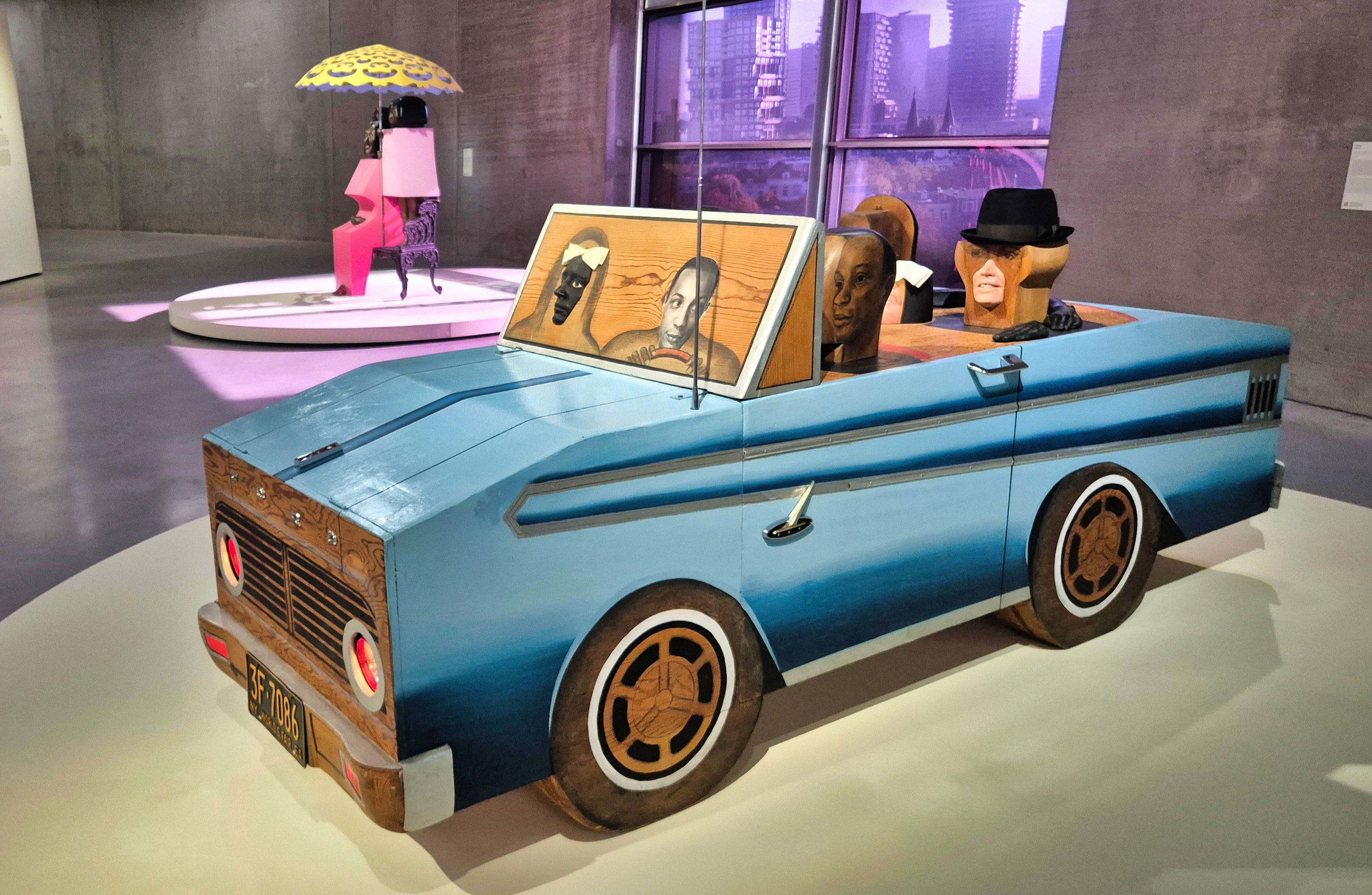
Also on view is one of the early iconic pieces which featured in the Boijmans van Beuningen show in 1972, Marisol’s almost life-size blue car, occupied by a number of passengers, some African American, seemingly cruising around on a night out, or being chased by New York cops after a crime, Marisol herself being part of the gang. Again here, though some elements of the work seem relatively crude, the faces of the characters are exquisitely painted, bringing the piece alive.
There seem to have been no boundaries to her work. She collaborated with Martha Graham and the Louis Falco Dance Company as well as working with fashion. She frequently chose to disappear, fleeing when the pressure of her success became too great. In the early 1970s she fled to Tahiti to learn scuba diving. Discovering the miracles of the underwater world she produced a new style of work of sea creatures. The new fluid and smooth forms, in a break to her chunky wooden sculptures, were not well received. But despite this interlude, Marisol’s star, her defiance and her energy were neither tarnished nor extinguished.
The start of Marisol’s life was charmed – her family belonged to the Venezuelan oil millionaire elite. When her mother committed suicide when Marisol was just eleven, the shock plunged her into a decade in which she did not speak and resorted to extreme forms of penance. She had a very itinerant childhood – born in Paris she was shunted between boarding schools in Venezuela and Los Angeles.
She attended art schools in Paris. Finding the teaching old fashioned, aged twenty, moved to New York, was taken up by the iconic art dealer Leo Castelli, eventually dropping him to suddenly leaving New York for Italy. She was at home everywhere and nowhere and had the means to move at will.
Though my parents were impoverished WWII refugees, I was also moved from country to country, dropped into school after school which brought with it a hiding of emotions, a questioning of one’s own nationality, and the same kind of defiance I see in her eyes.
What resonated with me most was her remark: “I am the Venezuelan, born in France, living in Italy – that has an English car with North American plates and Swiss insurance – and they want to ask me what nationality I am”, a quote I could safely inscribe on my own identity papers. Astrid Burchardt, 9th October 2026
The exhibition continues until 29th March 2027