When the first Apple Mackintosh landed on my desk at the London city magazine Time Out, the future, it was believed, was going to be ‘The Paperless Office’. No more cutting, pasting bits of paper and photos onto grids, no more typesetting galleys; just journalists keyboarding copy joined with designers layout – and off to print! Paper was shown the door – or so people said. How wrong they were. Not only did we increase paper in offices, we realized that without paper much could not be done. For most creatives paper is the lifeblood. Despite the E-readers et al, the printing of books has ballooned. Not only that – whenever governments need verification of your identity, financial or work records, neither an email nor a screenshot will satisfy them - just a good old-fashioned sheet of paper with a real signature.
As artists around the world did not submit to being deprived of paper they declared war and there has never been such variety of creative work as there is today. In one of my lives I worked with papers from a 17th century paper mill in the Dordogne. Their workshop was like a cathedral with hundreds of handmade sheets of cotton paper hanging from the ceiling – awe inspiring.
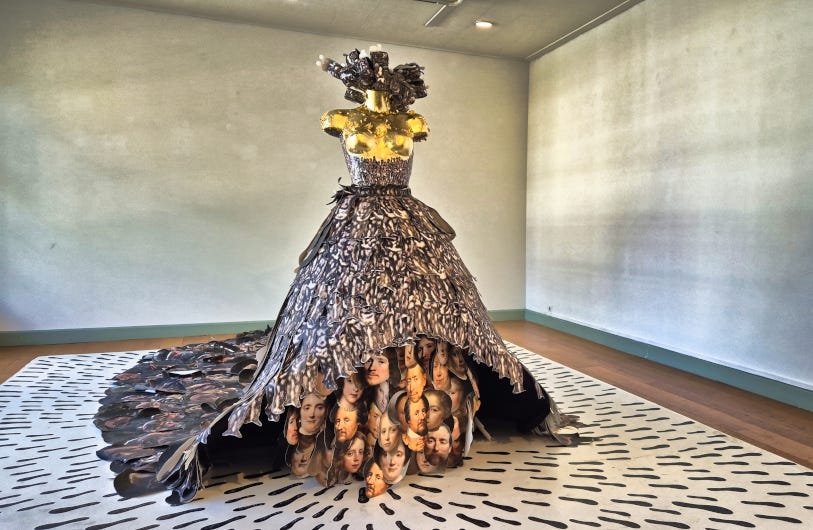
As before here in the PAPIER BIËNNALE 2026 on the theme of Family Connections, paper speaks. Bengali-Indian artist Maksud Ali Mondal’s passion is the observation of natural phenomena of all kinds. Here his crushed egg boxes are transformed into giant termite structures, illustrating the vital role of collaboration and knowledge transmission. Another giant papier maché piece by Karina Beumer deals with her father’s brain injury, the labyrinth of one’s memory and asks whether a person can be aware of identity without a functioning brain. Dutch-Khmer artist Samboleap Tol’s giant Cosmic Tortoise describes the weight he felt at his father’s death and the associated diaspora trauma. Sithabile Mlotshw’s installation has a room all to itself - the figure of a woman in a sumptuous dress entirely made of faces, Dutch faces peer out from under the skirt, the sides and the train is made of hundreds of indigenous people. A truly stunning work.
Among other exhibits dealing with historical documents transformed into works of art, what affected me most was Marie Ilse Bourlanges’ work which has parallels in my own family. She performs the shredding of documents – at first it seems to be the sort that I myself long to destroy but find, that after decades, some office in the six countries I have lived in wants paper proof that I’m actually alive. Marie Ilse’s shredding was triggered by the fragmented, often chaotic accounts of her grandmother’s thirty year residence in a psychiatric hospital in France. When she began to search for the true story she found that though the French government carefully preserved even the most banal financial records, her grandmother’s medical records, according to a recent law, had been destroyed just ten years after her death.
So here it’s all about family connections and mysteries. There is much, much more in this important and soul searching exhibition which is worth spending time to investigate. Astrid Burchardt, 4th October 2026
The exhibition continues until 28th February 2027