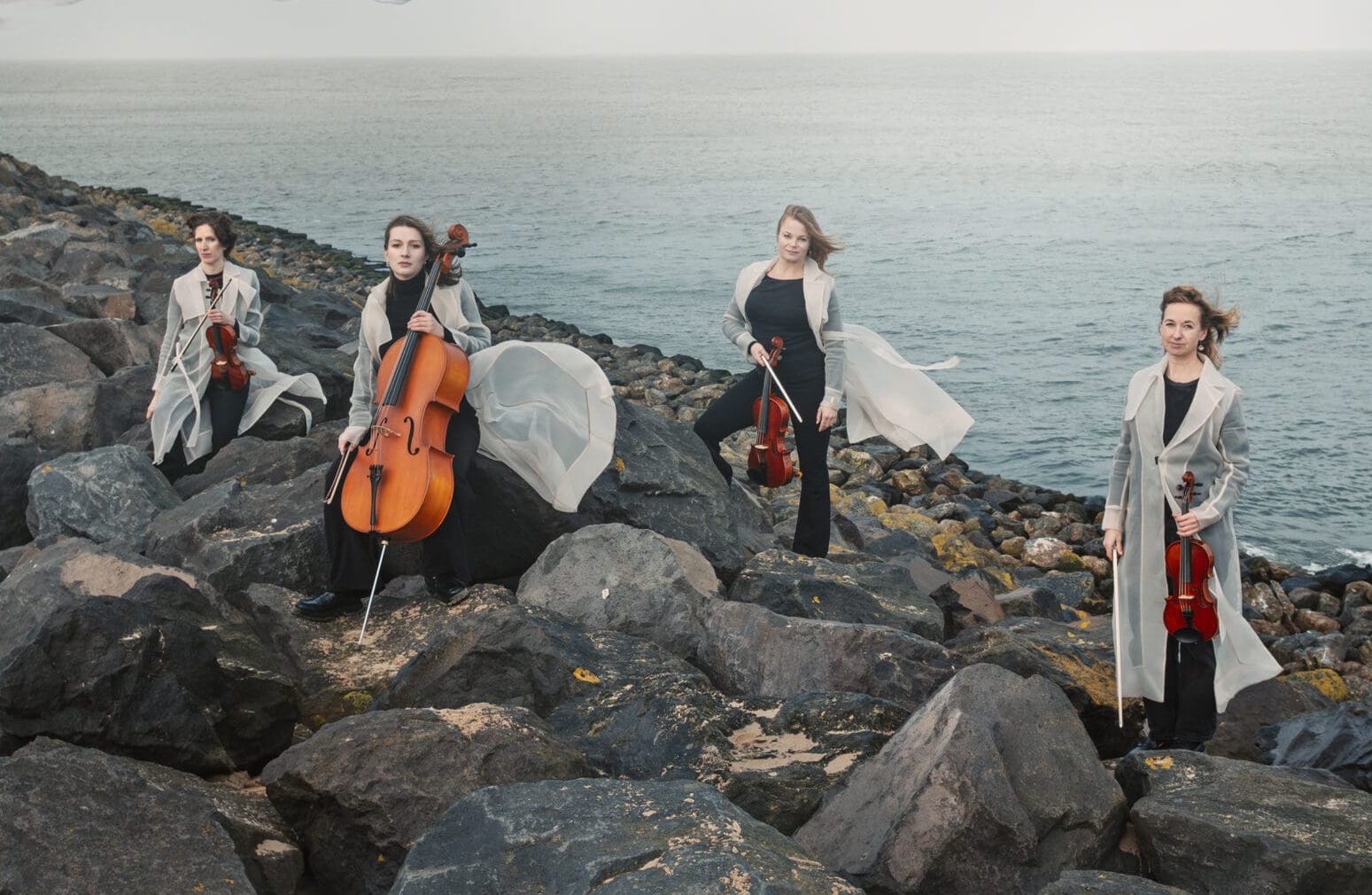
With the days getting shorter and next weekend getting even shorter when the clocks go back it is fitting that the Ragazze Quartet has assembled a programme including some Scandinavian music from the even darker north to herald the imminent arrival of winter.
Put together by the Quartet’s cellist Nathalie Flintrop, the concert Voces Intimae explores and reveals her love of music from a cold climate. While at the Conservatory of Amsterdam she became engrossed in the music of Jean Sibelius which led to her reconstruction and composition of a missing part of his unfinished string trio.
The wet and windy Sunday morning in Delft certainly created the right atmosphere for the concert as coats and scarfs were handed in to the cloakroom. In Voces Intimae the Ragazze Quartet, made up of Rosa Arnold and Jeanita Vriens-van Tongeren, violins, Annemijn Bergkotte, viola and cellist Geneviève Verhage standing in for Nathalie Flintrop, interwove musical voices from the north: the timeless power of Nordic folk music, the abstract, almost physical poetry of the recently deceased Finnish composer Kaija Saariaho and the introspective lyricism of Jean Sibelius. Folk melodies, passed on through memory and tradition were the roots of the first half of the programme. The concert started with four traditional Scandinavian folk songs arranged by the Danish Quartet. They were all quite cheery and bright and consequently defied any preconceptions we may have had. For me the one entitled Naja’s Waltz stood out.
Sibelius’s 1908 String Quartet in D minor, Op. 56, Voces Intimae is an intimate conversation between voices of the past and the present. The title refers both to the intimacy of the string quartet and to the inner voice of Sibelius. A work full of melancholy, reflection and inner peace with many references to the traditional folk music of Scandinavia.
Where Sibelius’ Voces Intimae refers to an intimate conversation between voices of past and present Dvořák’s String Quartet in Fmaj, Op.96, the American Quartet, is very much a thing of the present, upbeat and looking forward. Written during his three-year sojourn in the United States it was written more or less at the same time as the New World Symphony and the cross references and similarities in phrasing are clear. The American Quartet represented a turning point in the composer’s chamber music output and was written in less than two weeks. Dvořák defended the apparent simplicity of the piece saying, “When I wrote this quartet in the Czech community of Spillville [Iowa] in 1893, I wanted to write something for once that was very melodious and straightforward, and dear Papa Haydn kept appearing before my eyes, and that is why it all turned out so simply. And it’s good that it did.”
Ragazze Quartet’s interpretation was immaculate, bringing out the subtle nuances and colouring of the more exhilarating passages especially in the Molto vivace. I much prefer chamber to orchestral music and Ragazze displays a clarity and cohesion which epitomises all that is best about string quartets. Michael Hasted, 18th October 2026